
- Quickdraw - Ekspres
- Harness - Emniyet Kemeri
- Belay device - Emniyet alma aleti
- Sling - Perlon
- Carabiner - Karabina
- Rope - İp
- Helmet - Kask
- Climbing shoes - Tırmanış ayakkabısı
- Chalk - Magnezyum Tozu
- Chalk Bag - Toz Torbası
- Beta
- Crux - Bir rotanın en zor (kilit) bölümü
- Top rope climbing
- Bolt
- Anchor - İstasyon / Ankraj
Reference: https://en.wikipedia.org/wiki/Rock-climbing_equipment
Quickdraw – Ekspres #
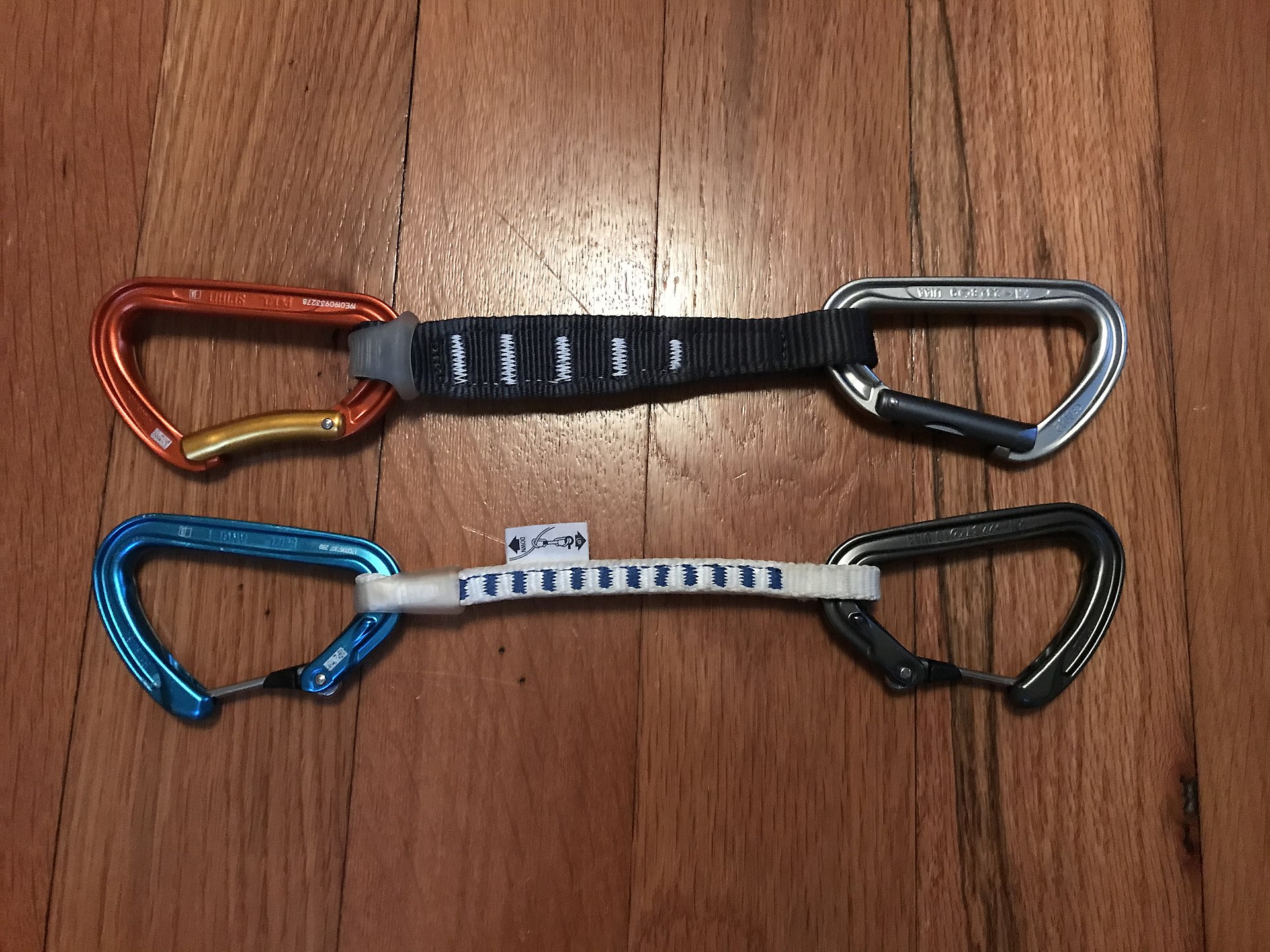
Quickdraws (often referred to as “draws”) are used by climbers to connect ropes to bolt anchors, or to other traditional protection, allowing the rope to move through the anchoring system with minimal friction. A quickdraw consists of two non-locking carabiners connected together by a short, pre-sewn loop of webbing. Alternatively, and quite regularly, the pre-sewn webbing is replaced by a sling of the above-mentioned dyneema/nylon webbing. This is usually of a 60 cm loop and can be tripled over between the carabiners to form a 20 cm loop. Then when more length is needed the sling can be turned back into a 60 cm loop offering more versatility than a pre-sewn loop. Carabiners used for clipping into the protection generally have a straight gate, decreasing the possibility of the carabiner accidentally unclipping from the protection. The carabiner into which the rope is clipped often has a bent gate, so that clipping the rope into this carabiner can be done quickly and easily. Quickdraws are also frequently used in indoor lead climbing. The quickdraw may be pre-attached to the wall. When a climber ascends the wall, (s)he must clip the rope through the quickdraw in order to maintain safety. The safest, easiest and most effective place to clip into a quickdraw is when it is at waist height
Harness – Emniyet Kemeri #

A harness is a system used for connecting the rope to the climber. There are two loops at the front of the harness where the climber ties into the rope at the working end using a figure-eight knot. Most harnesses used in climbing are preconstructed and are worn around the pelvis and hips, although other types are used occasionally.
Different types of climbing warrant particular features for harnesses. Sport climbers typically use minimalistic harnesses, some with sewn-on gear loops. Alpine climbers often choose lightweight harnesses, perhaps with detachable leg loops. Big Wall climbers generally prefer padded waist belts and leg loops. There are also full body harnesses for children, whose pelvises may be too narrow to support a standard harness safely. These harnesses prevent children from falling even when inverted, and are either manufactured for children or constructed out of webbing. Some climbers use full body harnesses when there is a chance of inverting, or when carrying a heavy bag. There are also chest harnesses, which are used only in combination with a sit harness. Test results from UIAA show that chest harnesses do not put more impact on the neck than sit harnesses, giving them the same advantages as full body harness.[6]
Apart from these harnesses, there are also caving and canyoning harnesses, which all serve different purposes. For example, a caving harness is made of tough waterproof and unpadded material, with dual attachment points. Releasing the maillon from these attachment points loosens the harness quickly.
Canyoning harnesses are somewhat like climbing harnesses, often without the padding, but with a seat protector, making it more comfortable to rappel. These usually have a single attachment point of Dyneema.
Belay loop: The strongest point on a climbing harness; the loop to which a belay device is physically attached. The belay loop will wear more quickly if anything is tied around the belay loop such as a daisy chain or sling.

Belay device – Emniyet alma aleti #
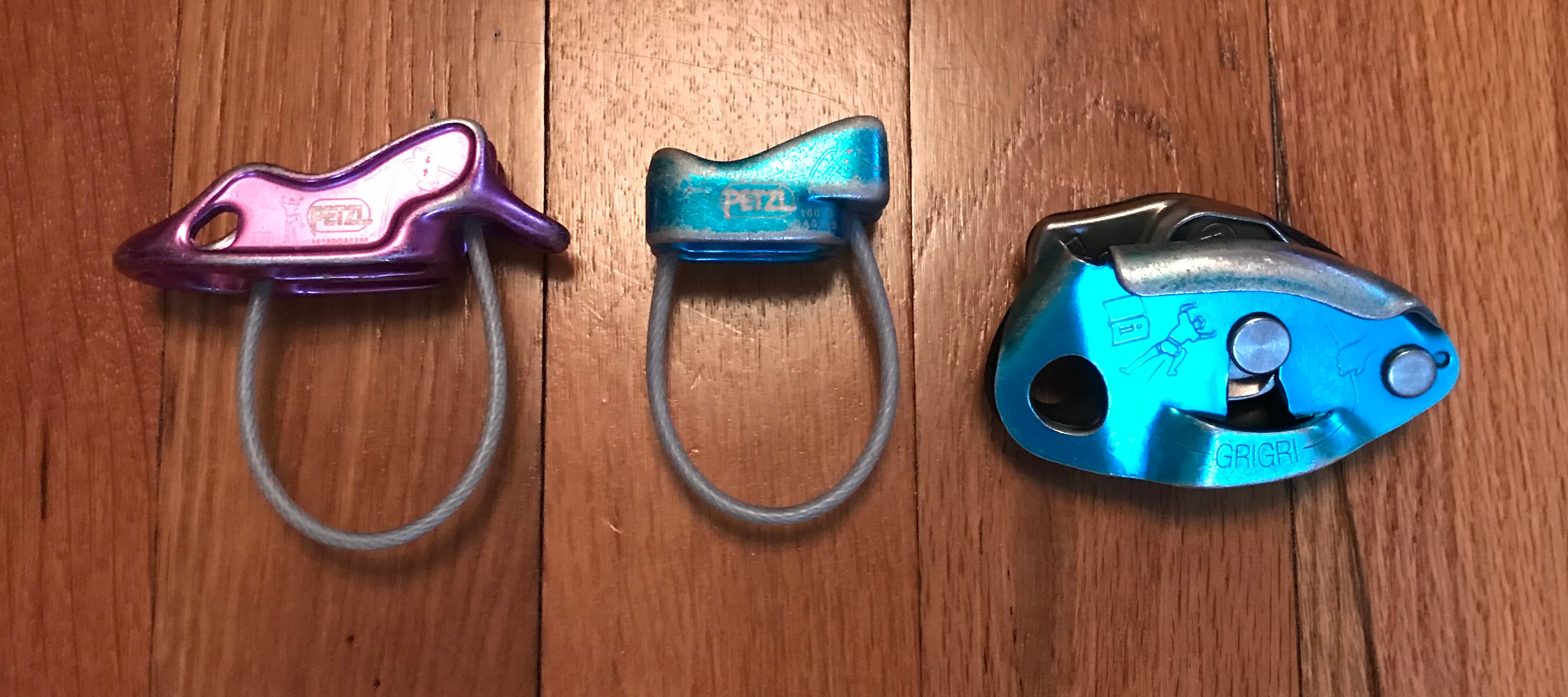
Belay devices are mechanical friction brake devices used to control a rope when belaying. Their main purpose is to allow the rope to be locked off with minimal effort to arrest a climber’s fall. Multiple kinds of belay devices exist, such as tubers (for example the Black Diamond ATC) or active assisted-braking devices (for example the Petzl Grigri), some of which may additionally be used as descenders for controlled descent on a rope, as in abseiling or rappelling.
If a belay device is lost or damaged, a Munter hitch on a carabiner can be used as an improvised passive belay device.
Sling – Perlon #

A sling or runner is an item of climbing equipment consisting of a tied or sewn loop of webbing that can be wrapped around sections of rock, hitched (tied) to other pieces of equipment or even tied directly to a tensioned line using a prusik knot, for anchor extension (to reduce rope drag and for other purposes), equalisation, or climbing the rope.
Carabiner – Karabina #

Carabiners are metal loops with spring-loaded gates (openings), used as connectors. Once made primarily from steel, almost all carabiners for recreational climbing are now made from a lightweight but very strong aluminum alloy. Steel carabiners are much heavier, but harder wearing, and therefore are often used by instructors when working with groups.
Carabiners exist in various forms; the shape of the carabiner and the type of gate varies according to the use for which it is intended. There are two major varieties: locking and non-locking carabiners. Locking carabiners offer a method of preventing the gate from opening when in use. Locking carabiners are used for important connections, such as at the anchor point or a belay device. There are several different types of locking carabiners, including a twist-lock and a thread-lock. Twist-lock carabiners are commonly referred to as “auto-locking carabiners” due to their spring-loaded locking mechanism. Non-locking carabiners are commonly found as a component of quickdraws.
Carabiners are made with many different types of gates including wire-gate, bent-gate, and straight-gate. The different gates have different strengths and uses. Most locking carabiners utilize a straight-gate. Bent-gate and wire-gate carabiners are usually found on the rope-end of quickdraws, as they facilitate easier rope clipping than straight-gate carabiners.
Carabiners are also known by many slang names including biner (pronounced beaner) or Krab.
The first climber who used a carabiner for climbing was German climber Otto Herzog.[5]
The Maillon (or Maillon Rapide) performs a similar function to a carabiner but instead of a hinge, it has an internally threaded sleeve engaging with threads on each end of the link, and is available in various shapes and sizes. They are very strong but more difficult to open, either deliberately or accidentally, so are used for links which do not need to be released during normal use, such as the center of a harness.
Rope – İp #

Climbing ropes are typically of kernmantle construction, consisting of a core (kern) of long twisted fibres and an outer sheath (mantle) of woven coloured fibres. The core provides about 70% of the tensile strength,[2] while the sheath is a durable layer that protects the core and gives the rope desirable handling characteristics.
Ropes used for climbing can be divided into two classes: dynamic ropes and low elongation ropes (sometimes called “static” ropes). Dynamic ropes are designed to absorb the energy of a falling climber, and are usually used as belaying ropes. When a climber falls, the rope stretches, reducing the maximum force experienced by the climber, their belayer, and equipment. Low elongation ropes stretch much less, and are usually used in anchoring systems. They are also used for abseiling (rappelling) and as fixed ropes climbed with ascenders.
Modern webbing or “tape” is made of nylon or Spectra/Dyneema, or a combination of the two. Climbing-specific nylon webbing is generally tubular webbing, that is, it is a tube of nylon pressed flat. It is very strong, generally rated in excess of 9 kN (2,000 lbf). Dyneema is even stronger, often rated above 20 kN (4,500 lbf) and as high as 27 kN (6,100 lbf).[3] In 2010, UK-based DMM performed fall factor 1 and 2 tests on various Dyneema and Nylon webbings, showing Dyneema slings can fail even under 60 cm falls. Tying knots in Dyneema webbing was proven to have reduced the total amount of supported force by as much as half.[4]
When webbing is sewn or tied together at the ends, it becomes a sling or runner, and if you clip a carabiner to each end of the sling, you have a quickdraw. These loops are made one of two ways—sewn (using reinforced stitching) or tied. Both ways of forming runners have advantages and drawbacks, and it is for the individual climber to choose which to use. Generally speaking, most climbers carry a few of both types. It is also important to note that only nylon can be safely knotted into a runner (usually using a water knot or beer knot), Dyneema is always sewn because the fibers are too slippery to hold a knot under weight.
Webbing has many uses such as:
- Extending the distance between protection and a tie-in point.
- An anchor around a tree or rock.
- An anchor extension or equalization.
- Makeshift harnesses.
- Carrying equipment (clipped to a sling worn over the shoulder).
- Protecting a rope that hangs over a sharp edge (tubular webbing).
Helmet – Kask #

The climbing helmet is a piece of safety equipment that primarily protects the skull against falling debris (such as rocks or dropped pieces of protection) and impact forces during a fall. For example, if a lead climber allows the rope to wrap behind an ankle, a fall can flip the climber over and consequently impact the back of the head. Furthermore, any effects of pendulum from a fall that have not been compensated for by the belayer may also result in head injury to the climber. The risk of head injury to a falling climber can be further significantly mitigated by falling correctly.
Climbers may decide whether to wear a helmet based on a number of factors such as the type of climb being attempted, concerns about weight, reductions in agility, added encumbrances, or simple vanity. Additionally, there is less incentive to wear a helmet in artificial climbing environments like indoor climbing walls (where routes and holds are regularly maintained) than on natural multi-pitch routes or ice climbing routes (where falling rocks and/or ice are likely).
Climbing shoes – Tırmanış ayakkabısı #

Specifically designed foot wear is usually worn for climbing. To increase the grip of the foot on a climbing wall or rock face due to friction, the shoe is soled with a vulcanized rubber layer. Usually, shoes are only a few millimetres thick and fit very snugly around the foot. Stiffer shoes are used for “edging”, more compliant ones for “smearing”. Some have foam padding on the heel to make descents and rappels more comfortable. Climbing shoes can be re-soled which decreases the frequency that shoes need to be replaced.
Chalk – Magnezyum Tozu #
Chalk Bag – Toz Torbası #

Chalk is used by nearly all climbers to absorb problematic moisture, often sweat, on the hands. Typically, chalk is stored as a loose powder in a special chalk bag designed to prevent spillage, most often closed with a drawstring. This chalk bag is then hung by a carabiner from the climbing harness or from a simple belt worn around the climber’s waist . This allows the climber to re-chalk during the climb with minimal interruption or effort. To prevent excess chalking (which can actually decrease friction), some climbers will store their chalk in a chalk ball, which is then kept in the chalk bag. A chalk ball is a very fine, mesh sack that allows chalk release with minimum leakage when squeezed so that the climber can control the amount of chalk on the hands.
Chalk is most frequently white, and the repeated use of holds by freshly-chalked hands leads to chalky build-up. While this isn’t a concern in an indoor gym setting, white chalk build-up on the natural rock of outdoor climbs is considered to be an eyesore at best, and many consider it a legitimate environmental/conservation concern. In the United States, the Bureau of Land Management advocates the use of chalk that matches the color of the native rock.[14] Several popular climbing areas, like Arches National Park in Utah, have banned white chalk, instead allowing the use of rock-colored chalk. A handful of companies make colored chalk or a chalk substitute designed to comply with these environmental conservation measures. Garden of the Gods in Colorado has gone further, banning the use of all chalk and chalk substitutes outright.
Beta #
(Belirli bir tırmanış rotasının nasıl başarıyla tamamlanacağına ilişkin tavsiyeler, ipuçları veya genel bilgiler)
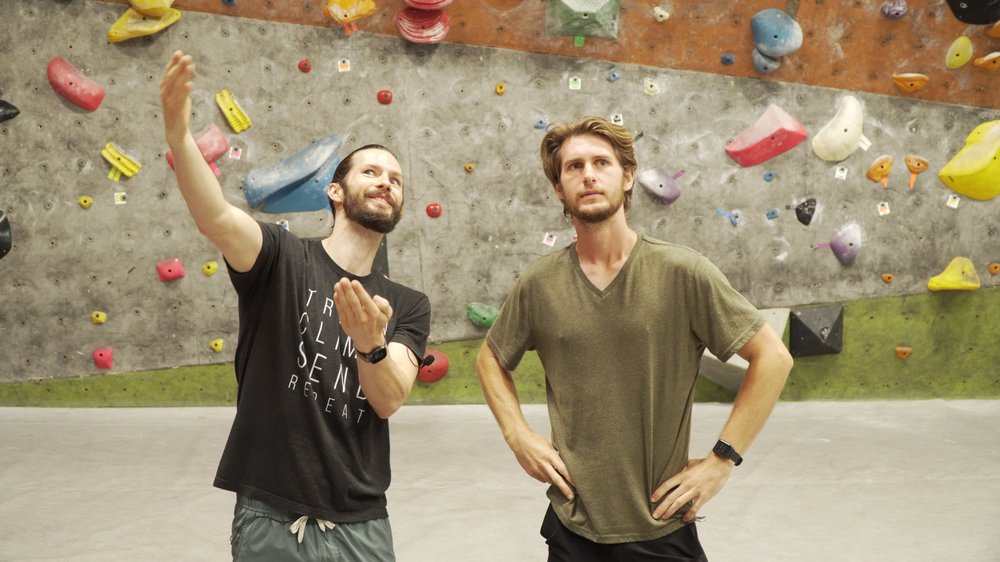
Advice, tips, or general information on how to successfully complete (or protect) a particular climbing route, boulder problem, or crux sequence. Some climbing purists believe that obtaining beta prior to attempting a route “taints” an ascent.
Crux – Bir rotanın en zor (kilit) bölümü #
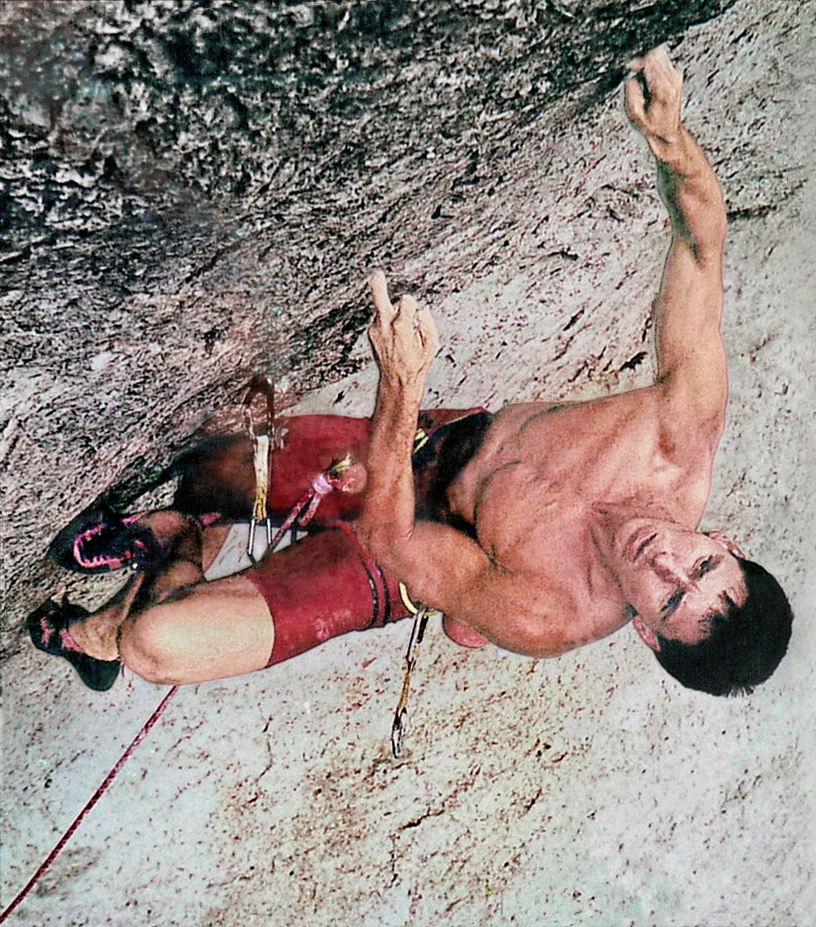
A crux in climbing, mountaineering and high mountain touring is the most difficult section of a route, or the place where the greatest danger exists. In sport climbing and bouldering, the most technically challenging point in the climb is also called the crux section.[1] In describing a climbing route using a topo, cruces (or cruxes) are usually shown with a key symbol.
The grade of a climbing route is based on the technical difficulty of the crux (e.g. 8a (5.13b) in the sport climbing system, or V13 (8B) in the bouldering system), and for traditional climbing routes, an additional grade is used for the risk of personal injury to a climber of a fall at the crux (e.g. the British E-grade system). That means the rest of the route might be considerably easier, however, a route may comprise several cruces of equal difficulty, or simply be a route of a very consistent level of difficulty with no sections that stand out as harder than the rest.
In planning a route it is important to know how far it is before the crux is reached, because cruces (or cruxes),[2] can only be overcome with sufficient reserves of strength.[3] Sport climbers have come to use a kneebar to rest before, or immediately after, a crux; they can also continually practice a crux using top roping.
Top rope climbing #

Top rope climbing (or top roping) is a form of rock climbing where the climber is securely attached to a climbing rope that runs through a fixed anchor at the top of the route, and back down to the belayer (or “second”) at the base of the climb. A climber who falls will be held by the rope at the point of the fall, and can then either resume their climb or have the belayer lower them down in a controlled manner to the base of the climb. Climbers on indoor climbing walls can use mechanical auto belay devices to top rope alone.
By definition, top roping can only be done on routes that are less than half the length of a typical climbing rope, which means single-pitch routes that are below 25–30 metres (82–98 ft) in height. Top roping is also used in ice climbing, and the related sports of mixed climbing and dry-tooling, and it is used in combination with auto belay devices in both competition speed climbing and competition ice climbing.
Top roping is one of the safest forms of rock climbing and is used by most beginners and novices of the sport. Before the era of sport climbing, top roping a route for practice (known as headpointing or hangdogging) was considered poor practice; however, it is now a legitimate technique in preparing for a redpoint ascent. Top roping a new route is not considered a first free ascent of a climb, and because of the ability of the belayer to give aid to the climber, it is not strictly free climbing (although some advocate that with slack, it is similar to free climbing), and is thus differentiated from “normal” lead climbing.
Description: In top-roping, the climber and their belayer (or “second”), arrange a fixed anchor at the top of the climb and then hang the rope down from this anchor at the rope’s approximate mid-point, so that two parts of the rope are now hanging down the route. By definition, top-roping is only possible where the climbers can get to the top of the route by other means so that they can set up the anchor and pass the rope through it.
Once the top rope is set up, the climber is then tied to one end of the rope (using a figure-eight loop follow-through knot), and the belayer clips their belay device into the other side of the hanging rope. As the climber ascends the route, the belayer “takes in” the “slack” in the rope, so that a climber who falls can simply hang from the rope, unlike a lead climber who falls at least twice the distance to their last point of climbing protection.
In top-roping, the climbing rope needs to be at least twice the length of the climbing route (because the rope goes to the top of the climbing route and back to the climber who is starting at the ground level). As typical climbing ropes are 50–60 metres (160–200 ft) in length, it means that top-roping is only done on routes that are 25–30 metres (82–98 ft) in height (if not shorter, for safety), which are single-pitch routes.
A belayer who takes in all the slack and maintains a high level of tautness in the rope is giving the climber a source of artificial aid in ascending the route. A physically strong belayer, or a belayer with a light climber, can physically haul the climber up the route by pulling on the rope. Because of this, top roping is not considered free climbing (and nor is it considered lead climbing), and a top rope ascent cannot be used to claim a first free ascent (FFA) of a new climb.
Bolt #

In rock climbing, a bolt is a permanent anchor fixed into a hole drilled in the rock as a form of climbing protection. Most bolts are either self-anchoring expansion bolts or fixed in place with liquid resin. Climbing routes that are bolted are known as sport climbs, and those that do not use (or allow) bolts, are known as traditional climbs.
Description: While bolts are commonplace in rock and gym climbing there is no universal vocabulary to describe them. Generally, a bolt hanger (or a fixed hanger) is a combination of a fixed bolt and a specialized stainless steel hanger designed to accept a carabiner, whereas in certain regions a bolt runner (or a carrot) describes a hangerless bolt (where the climber must provide their own hanger bracket such as a rivet hanger). A climbing rope is then clipped into the carabiner. Generally quickdraws or slings are employed between bolt hangers and the rope to reduce drag when ascending, belaying and rappelling.
Types: Variations of climbing bolts include: Ring bolt has a loop on one end so it presents as a U-shape embedded in the wall. Glue-in bolt resembles a pin that is popular in Europe. Carrot bolt is a metal hex-headed machine bolt used in Australia to function like a bolt but with no fixed bolt hanger attached; climbers attach to the carrot bolt by using a version of a rivet hanger or by attaching a removable bolt hanger plate.
Use: Rock climbing routes that have been bolted for climbing protection — but not as a source of aid to help progression — are called sport climbs. Where a route has bolts to aid progression (i.e. a climber can pull on the bolt), it is called an aid climb. In competition lead climbing, all of the routes are bolted.
Lifespan: Bolts degrade over time — particularly in coastal areas from salt, but also from stress corrosion cracking — and eventually, all sport climbs need to be re-fitted after a number of years. The highest quality titanium bolts are too expensive to use regularly, and the next highest quality stainless steel bolts have an expected lifespan of circa 20—25 years (the cheaper plated stainless steel bolts have a shorter span); and in 2015, the American Alpine Club established an “anchor replacement fund” to help replace the bolts on America’s estimated 60,000 sport climbing routes.
Anchor – İstasyon / Ankraj #

In rock climbing, an anchor can be any device or method for attaching a climber, rope, or load to a climbing surface—typically rock, ice, steep dirt, or a building—either permanently or temporarily. The intention of an anchor is case-specific but is usually for fall protection, primarily fall arrest and fall restraint. Climbing anchors are also used for hoisting, holding static loads, or redirecting (also called deviating) a rope.
Types: Depending on the surface being climbed, there are many types of protection that can be used to construct an anchor, including natural protection such as boulders and trees, or artificial protection such as cams, nuts, bolts or pitons.
Natural: A natural anchor is a secure natural feature that can serve as a climbing anchor by attaching a sling, lanyard, or cordelette and a carabiner. Examples of natural anchors include trees, boulders, lodged chockstones, horns, icicles, and protrusions.
Artificial: An artificial anchor consists of man-made climbing gear placed in the rock. Such gear includes spring-loaded camming devices, aluminum nuts used like chockstones, steel expansion bolts, and pitons. Artificial anchors may be permanent or removable.
Belay: A belay anchor is used as a sole attachment to the cliff face, to support a belay or top rope. Ideally, it should consist of multiple redundant components (natural and/or artificial), none of which are likely to fail, and none of which in the event of failure would cause the entire anchor to fail. Any component of a good anchor should be able to support the entire system by itself.
Running belay (Main article: Simul climbing): A running belay anchor is used as a safeguard in the event of a fall while lead climbing. The leader and follower climb simultaneously with protection placed in between. When the two climbers advance using a running belay, the belay is almost as secure as using a belay device and anchors because if the leader falls, all the slack is already out of the rope and the follower acts as a counterweight to catch the fall. A running belay is used as a faster alternative to pitch-climbing when the risk, consequences, and likelihood of a leader fall are deemed to be acceptable.
Ice: The snow picket is used as an anchor in mountaineering. It is driven into the snow and used to arrest falls. Snow pickets can also be placed horizontally in snow as a deadman, which provides a secure anchor to abseil on. Ice screws can be hand-driven into solid ice and are the equivalent of cams or nuts when ice climbing. Ice can also be protected using an Abalakov thread or v-thread. Because of the uncertain holding power of ice protection, it is sometimes attached to the rope using a load-absorbing sling or quickdraw, designed to reduce the load on protection by extending in case of a fall.


